

Before we start, let’s just review what metaphors do.
Metaphors help us explain complex concepts. They refer to something in a way that makes clear the subject without identifying all the minutiae. On some occasions, we all know the details anyway, and at other times more detail isn’t going to help advance the conversation or could even make it too tricky. As is the case when we use word metaphors such as “the elephant in the room” or “waves of sadness”.
There are also occasions when we use a metaphor to identify some event or feature that we cannot readily as yet explain well. Scientists make use of metaphors in these circumstances; it helps them to talk about the direction of their research and their hunches and intuitions on how an aspect is likely to function. An example here would be atoms “bumping into one another”.¹
Totemics talks about visual metaphors, because of the suites of images and objects that go alongside words, to create and make the metaphor type conversations. With the addition of an image or object we can say something about an intent or a characteristic long before we would be able to sensibly commit to detail.
We have created a practice routine to help in getting more familiar with the way a visual metaphor works and as with learning how to tie a shoelace or how to ride a bike, just being practical and having a go is the only way to master the art of visual metaphor making.
Here are the four images that we have selected for this practice routine. Have a good look.


The first step is to make a note of what comes to mind about each of them as we look at them.
As guidance, the thoughts from the two of us are as follows…
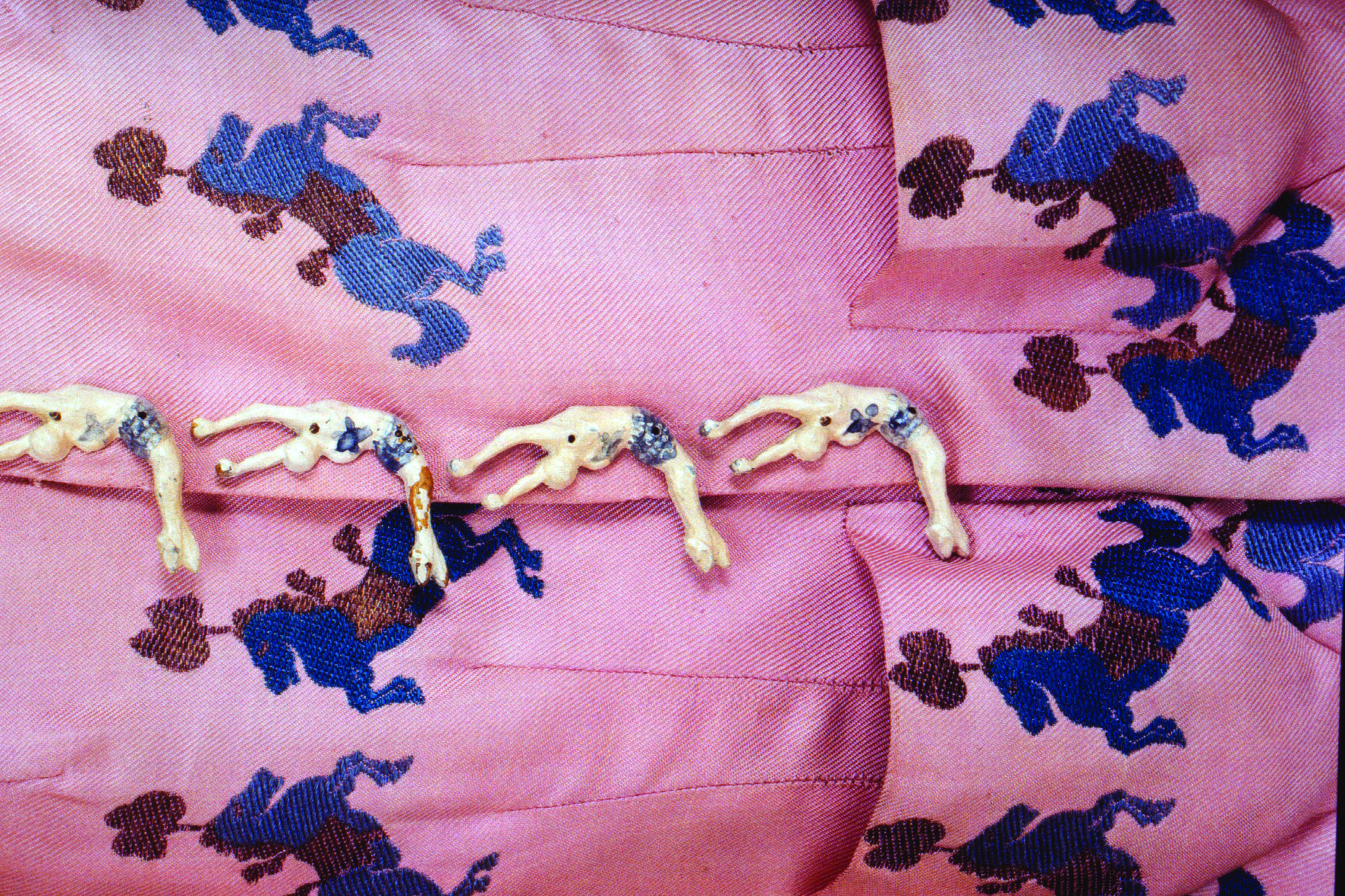
Purple Textile One of us…Generous, convoluted, soft and friendly The other…Dense, restless, moody, alive
White and Gold Textile One of us…Upright, clear and shiny sharp The other…Sparse, considered, corporate, somehow calm
Black and White Textile One of us…Warm, approachable geometry The other…Bold, angular, confident, uncompromising
Gold Jacket & Button One of us…Shiny, old school elegance The other…Rich, tactile, quietly self-assured
Our next task is to discuss our notes and arrive at a few words that we can agree upon. So that we don’t go round and round in circles, we move on to the next step – never miss this out – This step starts to think about the four images metaphorically. It is important that we use something simple that everyone has experience of to get the conversation going.
We take the four images and our words we used to describe each image and we think of them as standing for four restaurants and we ask ourselves, which do we choose, for example, would we go to meet old friends, when we are celebrating a special birthday, and finally, when we are just tired and hungry? Once we have done the restaurants, we repeat the process with something quite different, and now we think of the four images as being a piece of music.
These brief routines and their conversations allow us to explore how we might be “seeing things differently”, how we might “see” different qualities in each of the images and how we might be making different assumptions. Doing all this helps us to understand not only the differences in individual mindsets but the values of each mindset.
We just get a better intuitive grasp on how each of us approaches thinking about things. As we do this, the four textile images and their metaphoric role come into better focus. We are ready to move on.
Going Deeper into Creating a Working Visual Metaphor
The next step takes us into practice in holding the kind of initial metaphor conversation that might happen in a live project. You might be doing this practice alone but try to keep in mind that it is also practice that can be done with a small group and when this is the case then we can all be surprised by the diversity that can exist across us all.
There are two options here, read both and then first try the one that is closer to your own experience.
Practice One: Creation of an instruction manual and interactive interface for a next-generation smart refrigerator
We are imagining that the project will see paper instruction manuals entirely phased out, an interactive interface that manages fridge stock control, food safety and re-ordering, and a discreet small device that is housed in or on the refrigerator façade.
We put the four images to work. We ask ourselves, is there one that might stand as the hard point for the visual metaphor? One that we could see as standing in a more key role than the others. And, is there one we consider irrelevant?
For example, at first thought, image one (purple) is less likely, but then one of us says, wait a minute! If we think about the manual aspect from the owner or user perspective, it must appear instantly to be friendly, metaphorically soft to the touch, approachable and warm even. Not in how we create and build it, but how it is in use.
The black and white textile earns its place too, but for a different reason. Its sharp, ordered geometry feels right for what’s happening underneath the friendly surface, the stock control logic, the food safety checks, the quiet, exact bookkeeping the fridge is doing without the owner ever needing to see it. And the white and gold textile, oddly, starts to stand for the manual itself, or what’s left of it, clear, sparse, a little formal, the handful of instructions that still need to exist even once most of the paper has gone. Which of these three is likely to be the image that acts as the “hard point”; as able to take a key role in setting the tone. Ask, how the other images cluster around it and consider some key words or phrases.
We now have made an essential step in creating a working visual metaphor. We can use the images metaphorically to stand for aspects of essential values and attributes, no details, as it is way too early, but we have directions of travel that allow us to broadly explore aspects of the concept. If we were to continue, we might next conduct some preliminary investigations to test out aspects of the concepts held in our working visual metaphor and these might well end up as an inclusion within the briefing documents.
Practice Two: The Annual Assessment Process needs to be rethought and managed less centrally
We are imagining that the annual assessment procedures have come in for a good deal of past criticism, which still affects the way individuals feel about the company. They are outdated, even on occasions appear to be measuring/rewarding aspects that encourage hierarchical behaviours.
There has been a lot of change recently in the senior management team, and the effect of new blood is beginning to make a difference across the company. The new team think there is clearly a need for greater employee participation and transparency in annual assessment procedures.
We start once again by putting the four images to work, we look initially to image two and even image one as standing for less formality. We are about to discard image four, when one of us says, “steady on, a degree of formality is essential when it comes to pay rises and bonuses”. We realise they have a point – particularly with bonuses, which are always attractive, but we don’t want them to be seen as purely mercurial. The golden jacket has a job to do.
The white and gold textile turns out to matter here too. Once we’re talking about transparency, clear reporting, criteria people can actually see and understand, its sparseness stops looking like something to overlook. It starts standing for the plainness the new process needs, no more results dressed up or buried in vague language. Even the black and white geometry finds a role, standing in for the actual structure of the process itself, the sequence of conversations and sign offs, rather than the personality of any one manager running it.
We are beginning to assign the images and to see them standing for quite different and even perhaps conflicting aspects of an annual assessment process. We are on our way to our working visual metaphor, which image can best serve as the “hard point” here? An image able to take the key role. Do we need all four and what are our key words and phrases?
A next step would see us broadening out the conversation to include other divisions in the company always using our working visual metaphor as the reference and starting point. This way we explore and investigate what most employees feel would be vital to a good assessment.
Keep in mind that these two routines are to give practice in creating working visual metaphors.
Always remember, learning to tie a shoelace or ride a bike, you can’t learn these things, can’t actually get smart unless you do them. And practice is what it takes, practice and more practice – conversations and then more conversations!
¹ With thanks to the Udemy Team for their clear description of metaphor.